
The Code of 14
A two-hour class on number, sacred geometry, and embodied spiritual practice. Move from a pattern you can see to a practice you can use.
“We can use patterns of twelve to explore structure, seven principles to examine experience, and two circles to bring our relationship with the divine within and beyond into conscious practice.”
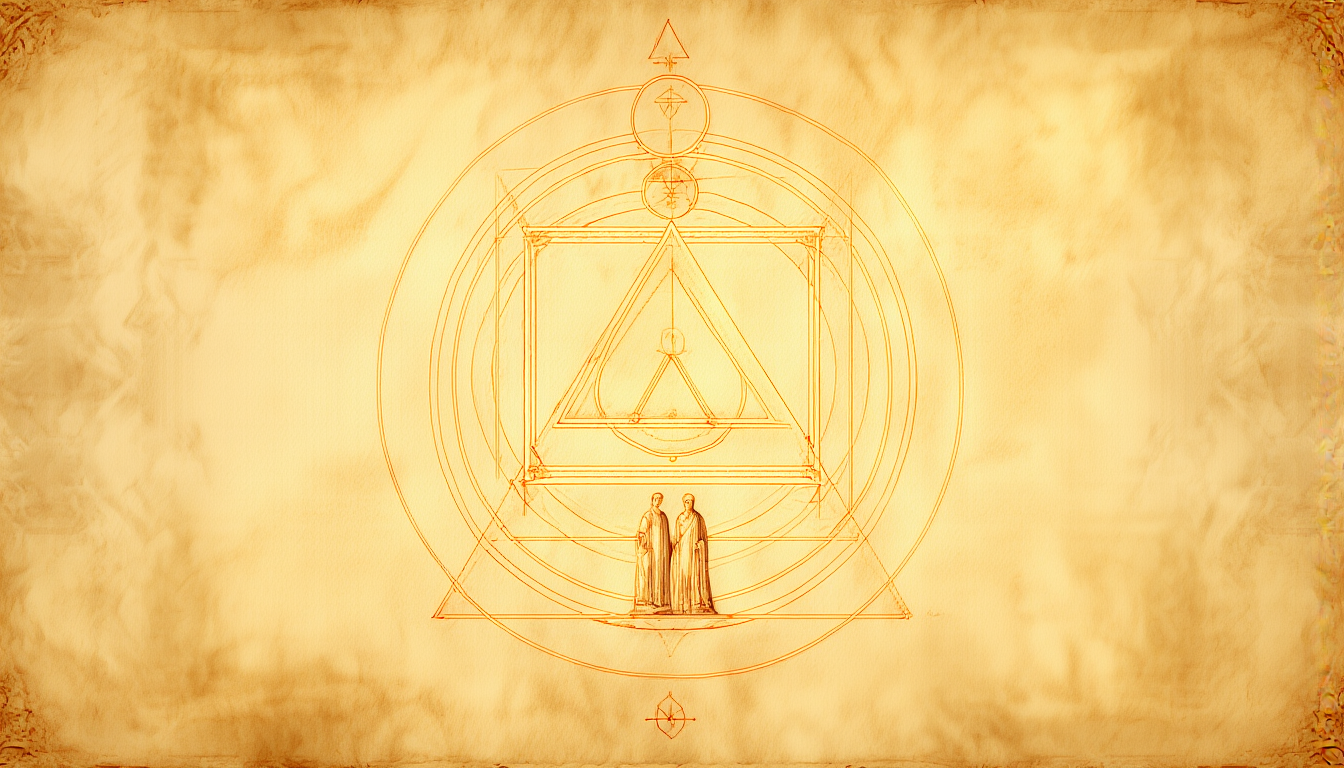
Three ways of knowing, clearly labeled
This class moves between things we can count, meanings a tradition has preserved, and the map you are developing through them. Every claim on this page carries one of three small labels. They are explained once, here, and then used quietly.
What can be counted
Something measured, counted, calculated, or documented. A count stays a count: twelve months, twelve cranial-nerve pairs, twelve edges of a cube.
What is preserved
A meaning attributed within a named text or community: the zodiac table, Sefer Yetzirah, The Kybalion, the history of the hexagram as the Magen David.
What is being developed
The meaning and practice forming in this class: the three-by-four matrix, the two circles, the fourteen-part contemplative map.
The label “14th-dimensional framework” can remain as spiritual terminology. It names a contemplative map — not a claim of fourteen spatial dimensions. Neither fourteen reflective components nor a result of fourteen establishes fourteen physical dimensions.
00:00–01:30
State the class promise: students will explore a symbol and turn it into a practical reflection tool.
01:30–02:30
Introduce the three labels above. They let you keep energy while making clear when you move from a source to your own teaching.
02:30–04:00
Ask each person to choose one recurring situation: an avoided conversation, an unresolved decision, or a habit they want to understand.
04:00–05:00
They write one sentence describing the situation — without explaining or judging it. That sentence is carried to the end of the class.
“Tonight we’re going to move from a pattern you can see to a practice you can use. Keep one real situation in mind. By the end, you’ll have a different set of questions to bring to it.”
Twelve shows up in many places
Observation Before twelve is treated as sacred, it must be counted honestly. Shared counts create useful comparisons. A shared count alone does not establish a common cause.
Four words keep the counting honest. A base is a rule for writing numbers: in base twelve, the quantity twelve is written 10 and fourteen is written 12. A count says how many things a list contains. A period says when a sequence repeats. A dimension counts independent coordinates in a specified setting. These are four different ideas.
Place-value notation. Twelve objects is not evidence anyone wrote in base twelve.
How many items a chosen list contains. Twelve months. Twelve nerve pairs.
When a repeating sequence closes. The moon’s cycle is ~29.53 days — not twelve.
Independent coordinates in a defined setting. Fourteen labels on a diagram is not fourteen dimensions.
Tap a card for the necessary precision. The category of what is being counted is the point of the exercise.
The calendar
Calendar systems differ; lunar cycles do not fit exactly twelve times into a solar year. A chosen structure of organization.
The clock
Cultural history. Minutes and seconds reflect sexagesimal — base sixty — conventions.
Measurement
A unit convention, not a biological law. Chosen structure.
Western music
Twelve pitch classes. The octave itself is a frequency ratio of 2:1. Other tuning systems exist.
The zodiac
A literal three-by-four table inside astrology. A classification within the tradition; it does not establish empirical personality prediction.
Cranial nerves
Count pairs, not single nerves, not isolated body points. Each pair serves defined sensory or motor function.
The thoracic spine
One spinal region. The whole spine develops as 33 vertebrae — seven cervical, twelve thoracic, five lumbar, five sacral, four coccygeal.
Jupiter’s orbit
Say “approximately twelve” and keep the Earth-year unit. A near-twelve astronomical cycle, not an exact one.
The cube
It also has six faces and eight vertices. Always specify the feature being counted.
The hexagram’s outline
Only if the counting rule includes the inward corners. The star still has six outer points — different features, different counts.
The hand
The thumb adds two, making fourteen per hand. These are finger bones, not the whole hand’s bones (five metacarpals and eight carpals are separate).
Particle physics
A count of mathematical generators (SU(3) × SU(2) × U(1)) — not a numeral base, not a spiritual dimension.
More from the bank — for questions and the handout: Revelation 21:12–21 names twelve gates, three on each of four sides, and twelve foundations — a directly stated three-by-four arrangement. Genesis 49:28 names twelve tribes. SN 12.2 names twelve links of dependent origination. The Greek pantheon groups twelve principal deities. Sefer Yetzirah lists twelve simple letters. A common Metatron’s Cube drawing places twelve circles around one center. The Chinese zodiac runs a twelve-animal cycle.
12:00–15:00
Explain the difference between twelve things and writing in base twelve. Divide twelve counters into halves, thirds, quarters, and sixths — twelve divides evenly by 2, 3, 4, and 6. That convenience is one practical reason twelve is useful; it is not the historical explanation for every appearance.
15:00–19:00
Calendar, clock, inches, music — about a minute each.
19:00–22:00
Cranial-nerve pairs, thoracic vertebrae, Jupiter’s approximately twelve-year orbit. Name the noun being counted; keep “approximately” on Jupiter.
22:00–25:00
Three qualities crossed with four elements. A real twelve-cell classification within its tradition.
25:00–26:00
Ask the room: which example is a cultural convention, which is anatomical, which is approximate?
“Now let’s see what happens when a pattern becomes a shape.”
When a pattern becomes a shape
A regular hexagram is built from two overlapping equilateral triangles. The same figure contains at least three different counts — of different features. Counting one thing is not counting everything. This distinction is the method of the whole class.
The capacity to begin, to express, to move first.
The capacity to listen, to allow, to contain.
Both belong to every person. My interpretation
Tradition The hexagram’s Jewish identity as the Magen David carries meanings with histories beyond this class — including one Jewish interpretation reading six extremities around a center. “Union of complementary qualities” is the framing used here; “union of opposites” and the alchemical coniunctio are other recognized descriptions. Masculine and feminine are the traditional symbolic vocabulary chosen for this work, not fixed rules about men and women.
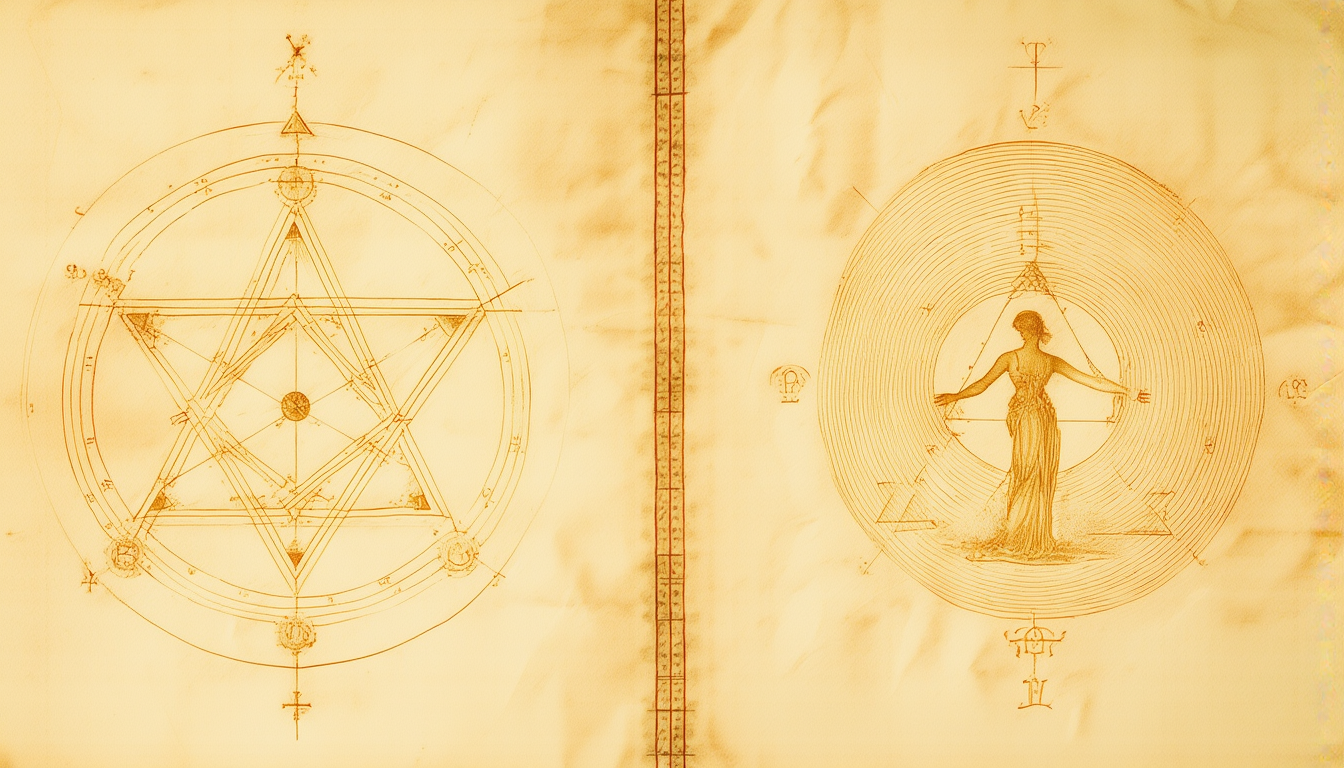
Tradition Michael Maier’s Atalanta Fugiens, emblem XXI (1617/18), depicts a man and a woman in a circle, within a square, within a triangle, within a larger circle, describing a progression through those shapes toward the philosopher’s stone. The emblem and the hexagram are not geometrically identical. The thematic bridge is union and transformation; the (3 × 4) + 1 + 1 formula is this class’s interpretation, not Maier’s text.
26:00–30:00
Draw two overlapping triangles. Use the exhibit to count six outer tips, six crossings, and six triangular regions around one central hexagon. Say why these are different counts of different features.
30:00–33:00
Present the masculine/feminine reading as symbolic qualities available to everyone. Invite students to name a situation that needs more expression, or more listening.
33:00–35:00
Name the Magen David and acknowledge meanings beyond this class. “One Jewish interpretation,” never “the one meaning.”
35:00–37:00
Introduce Maier’s emblem as a distinct alchemical image. Bridge: union and transformation. Not geometric identity.
“I’m using these two orientations to explore complementary capacities: the capacity to initiate and the capacity to receive. In this class, both belong to every person.”
“A shape can show us directions. A center gives us somewhere from which to relate to them.”
Six directions, and a center
Observation From any point there are six directions — up, down, left, right, front, back — and one place: the center. Six plus a center is seven. Students can point the directions while seated, or simply hold them in imagination.
Tradition Sefer Yetzirah 4:3 describes the six directions with “the Holy Palace established in the center, bearing them all.” The Gra version 6:5 adds seven as three opposite three, with one deciding between them — a precedent for a “three, three, plus one” balance image. These are cosmological correspondences; they do not say that halving a code of twelve produces a measurable ascent.
Tradition The same text organizes the Hebrew letters as 3 mothers + 7 doubles + 12 simples = 22 letters. A different plus-one convention exists in gematria: kolel adds one for a word considered as a whole. Six-directions-plus-center and kolel are two distinct candidates for a remembered “plus-one principle.” They are not presented here as the same rule, and neither is a universal law that every six ascends to a seven.
37:00–40:00
Demonstrate the six spatial directions from a center. Point, or imagine while seated.
40:00–43:00
Explain the documented Jewish interpretation of six directions or extremities and an integrating center.
43:00–45:00
Introduce the three / seven / twelve letter structure of Sefer Yetzirah. The groups total twenty-two.
45:00–47:00
Students write the orientation question above.
“Now we’ll move to a separate text and its seven principles.”
Seven principles, one text
Tradition The Kybalion was published in 1908 under the name “Three Initiates” — a book of the early twentieth century, distinguished from the earlier Hermetic literature. It presents seven principles, in this order:
All is Mind
Reality is understood as mental in nature.
As above, so below
Patterns correspond across planes of existence.
Nothing rests
Motion and vibration pervade existence.
Opposites are degrees
Opposites are related as poles of the same thing, differing in degree.
Everything swings
Movement has cycles, swings, and compensations.
Every cause has an effect
Events arise through causes and consequences. Do not silently substitute “karma” — that name introduces another tradition and additional meanings.
Generative principles
Generative masculine and feminine principles operate on all planes. A generative principle, not a statement about sex.
My interpretation The teaching arrangement for this class groups the first three as lenses for noticing — mentalism examines the story, correspondence compares patterns, vibration attends to movement and change — and the remaining four as themes for participation: polarity, rhythm, cause and effect, and generative/receptive symbolism. The book does not establish a doctrine of three exclusively spiritual and four exclusively material laws; it applies its principles across planes.
47:00–49:00
Identify The Kybalion, 1908. Distinguish it from earlier Hermetic literature. Do not call it an ancient Egyptian manuscript.
49:00–53:00
Explain mentalism, correspondence, vibration briefly, using the source definitions above.
53:00–57:00
Explain polarity, rhythm, cause and effect, and gender.
57:00–59:00
State explicitly that the first-three / last-four organization is the teaching arrangement. Preview the matrix after the break.
Seven headings. Twelve pairings.
Count it before you use it. Three row headings plus four column headings gives seven headings: 3 + 4 = 7. Their intersections give twelve relationships: 3 × 4 = 12. The multiplication counts the pairings — each of three lenses applied to each of four themes. Seven principles do not mathematically turn into twelve principles. This explains exactly what the multiplication counts.
examine the story
compare patterns
attend to movement
Situation: “I keep postponing a conversation about an unequal workload.”
- Mentalism × Polarity: “I believe I must either stay silent or start a fight.” A third option is a direct, calm request.
- Mentalism × Rhythm: “I postpone until I am exhausted, then I speak from frustration.” Schedule the conversation before that point.
- Mentalism × Cause and effect: “I assume the other person should already know.” State what is happening and what help is needed.
- Mentalism × Generative/receptive: Express the request, then leave room to hear the response.
- Inner circle: “I can own that I have not clearly made the request.”
- Outer circle: “I can respect the other person’s circumstances while asking for a workable agreement.”
- Action: “Tomorrow at 10 a.m., I will ask for a fifteen-minute conversation and propose one specific redistribution.”
My interpretation The questions are original teaching adaptations — not quotations from The Kybalion. “Vibration” is adapted here as a contemplative lens on change; these questions do not measure a physical frequency.
64:00–67:00
Count the seven headings and twelve intersections. Name the operation: each of three lenses is paired with each of four themes.
67:00–71:00
Work through the example above, one row at a time.
71:00–76:00
Students select one cell from each row and answer about their own situation. The full twelve-question matrix is for later use.
76:00–78:00
Invite two short observations, or summarize responses from chat.
“Three plus four tells us how many headings there are. Three times four tells us how many relationships we can explore. Seven principles; twelve pairings.”
The two circles
We have a map of relationships. Now we bring in the person using the map, and the larger whole that person belongs to. Two reflective commitments join the twelve pairings: the divine within and the divine beyond.
The divine within
Awareness, dignity, inner relationship with the sacred.
Practical question: “What can I notice, take responsibility for, and choose?”
The divine beyond
Connection with the greater whole, relationship and participation.
Practical question: “How does my choice honor the lives and relationships it affects?”
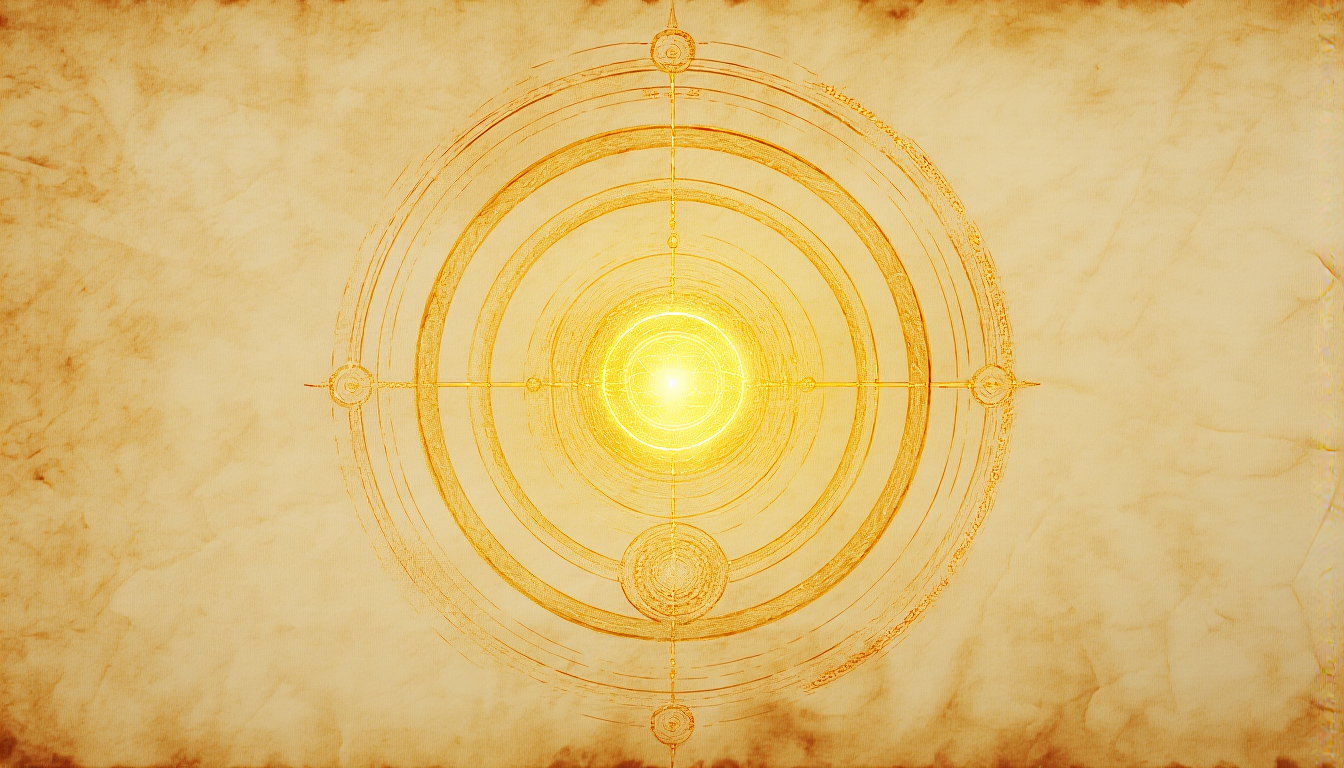
The labels name chosen components thirteen and fourteen of a contemplative map. They do not identify newly discovered anatomical points or spatial dimensions. Avoid treating the arithmetic as a test of whether another person embraces God — the theology comes from the interpretation of the image, not from a mathematical implication.
78:00–81:00
Trace the triangle, the square, and the two circles. Explain your chosen meaning of each circle.
81:00–84:00
Compare the two expressions. Multiplication by one preserves a value; choosing addition is your symbolic decision.
84:00–86:00
Inner question: “What can I notice, own, and choose here?”
86:00–88:00
Outer question: “How does my next action honor my relationship with other people, the world, and what I hold sacred?”
“I use addition as an image of consciously including two relationships: the divine within and the divine beyond.”
The body: anatomy, then symbolism
Observation Anatomy gives the structures. The spiritual relationships placed among them are part of the teaching. Keep the two apart.
Cranial nerves
Standard anatomy recognizes twelve pairs of cranial nerves, numbered I through XII. Pairs, not single nerves, not twelve body points.
Thoracic vertebrae
The thoracic region normally contains twelve vertebrae, T1–T12. The whole spine develops as thirty-three.
Pineal and heart
The pineal gland secretes melatonin and carries the light–dark signal. The heart’s electrical activity is measurable, and its weak magnetic signals can be recorded. Placing them beside the twelve pairs as items thirteen and fourteen is my symbolism, not an anatomical circuit.
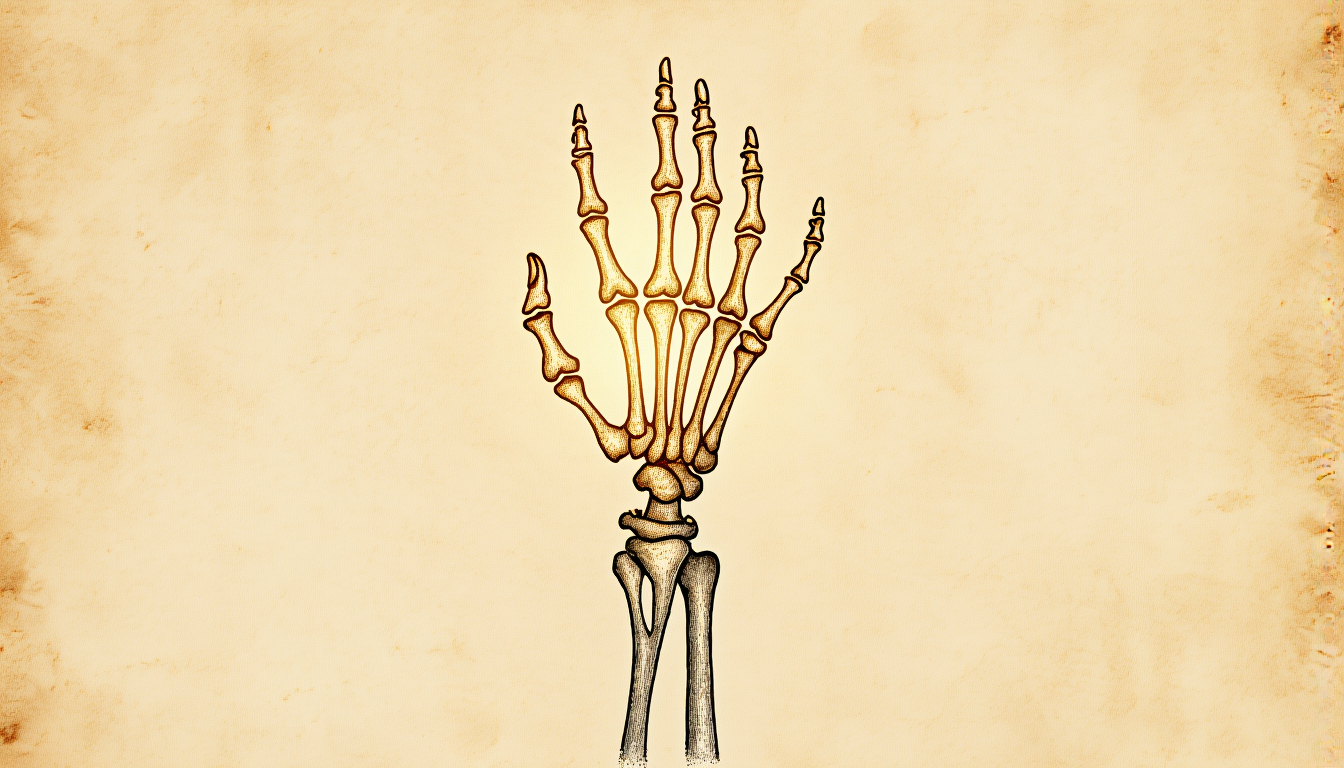
This is one place where the arithmetic really does appear in ordinary anatomy. The anatomical count is a fact; the meaning drawn from it is a spiritual interpretation. It is not evidence that a person has fourteen dimensions, or that the thumb biologically represents God.
88:00–91:00
Clarify the cranial-nerve and spinal counts. Refer to the appendix rather than reciting every structure.
91:00–94:00
Demonstrate the fourteen phalanges using the exhibit. Students trace their own digits without needing to feel every bone.
94:00–96:00
Describe pineal melatonin function and the heart’s electrical activity briefly. Label the placement as symbolism.
96:00–100:00
Guide the three-minute practice in the next module. Debrief: “What did you actually notice?”
“Anatomy gives us the structures. The spiritual relationships I place among them are part of my teaching.”
Three minutes, six turns of attention
No forced breathing, no breath retention, no gland activation, no promised physiological transformation. Eyes may stay open; the body may remain seated and observe without touching the chest. Sensations are experiences the student can describe — warmth, tingling, calm, or lack of change — not measurements of pineal activation.
Fourteen, in exact mathematics
Observation Fibonacci: F(0)=0, F(1)=1, each term the sum of the two before. Thirteen is a Fibonacci number — F(7) = 13. Fourteen is not; it lies between 13 and 21. And F(14) = 377 = 13 × 29. Exact, independently checkable, no interpretation required.
The complementary halves, modulo 13. The full cycle modulo 13 has period 28, splitting into two 14-term halves where each term of the second is the negative of its partner in the first — every nonzero pair sums to 13, zero pairs with zero: F(n+14) ≡ −F(n) (mod 13). An exact image of complementary halves; the spiritual meaning remains the class’s application.
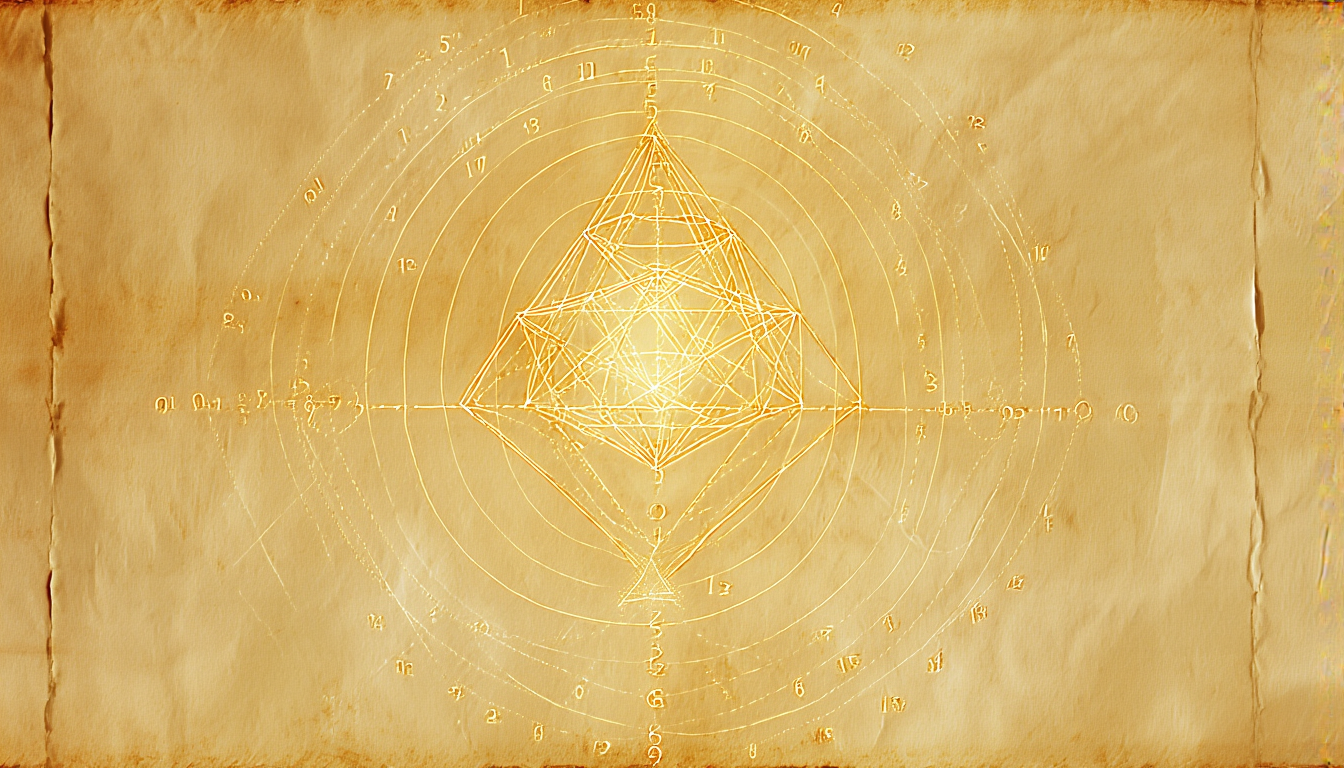
Twelve vertices, twenty-four edges, fourteen faces — eight triangles and six squares. Euler’s relation: 12 − 24 + 14 = 2. The dual rhombic dodecahedron reverses the counts: fourteen vertices, twelve faces. One structure, several numbers, depending on what is counted.
100:00–101:30
Explain the Fibonacci rule. Thirteen is in the sequence; fourteen is not.
101:30–105:00
Step the modulo-29 cycle live. Explain “modulo” as keeping only the remainder.
105:00–107:00
Turn the cuboctahedron. Twelve vertices, fourteen faces — vertices and faces are different features.
107:00–108:00
Ask students to name what each number counts. That is the core method of the class.
The hexagon exercise can replace the step-through in a hands-on session; keep the full Fibonacci answer in the handout. The mod-13 complement pattern, Catalan numbers, and further examples belong to the handout — showing all of them live overloads eight minutes.
The Higgs field: the actual finding
A physics field assigns quantities across spacetime. It is not a grid whose base changes when awareness changes. In the Standard Model, the Higgs field is a complex doublet — four real components. After symmetry breaking, three become the longitudinal modes of the W⁺, W⁻, and Z bosons; one physical Higgs mode remains. Counts of components are not numeral bases.
Electromagnetic
Associated with the photon, which remains massless. Local forces between charges.
Higgs
Contributes to the masses of elementary particles such as electrons and quarks. A precise mathematical object with its own role.
Spiritual
“Divine resonance” describes felt connection and meaning. A spiritual language, not a measured mechanism.
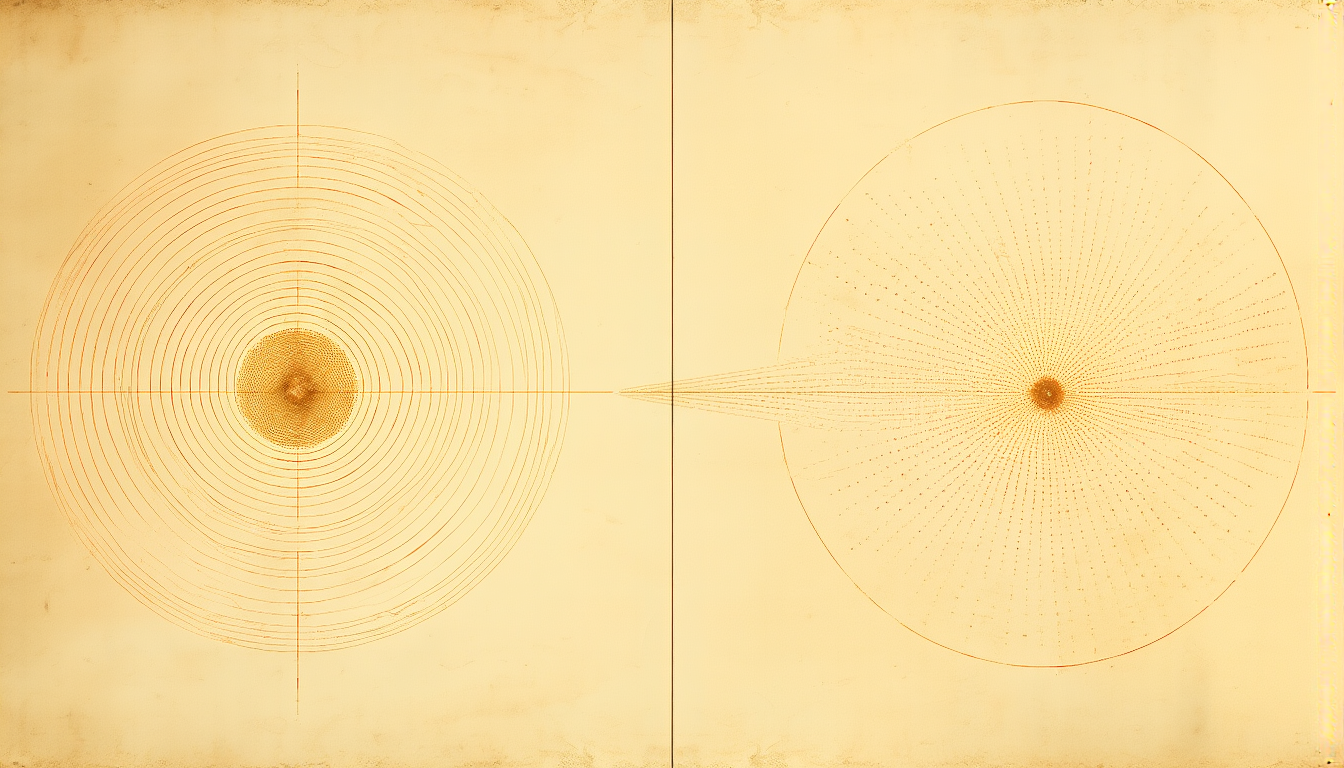
Observation Real twelves do occur in particle physics under specific counting conventions: the gauge generators 8 + 3 + 1 = 12, and twelve fermion flavors as three generations × four categories. Neither is a universal base-twelve code, and neither identifies twelve energy centers in a person.
The finding, stated plainly: no established evidence supports pineal–heart attention transmitting divine resonance into the Higgs field. The equations and detailed mode counts stay in the appendix — four minutes is enough to answer the question.
Take the symbol with you
The progression, end to end:
- Notice and accurately count examples of twelve.
- Explore the hexagram as an image of relationship between complementary qualities.
- Introduce six directions and a center as one source-grounded image of seven.
- Introduce the seven principles of The Kybalion.
- Arrange three principles against four principles to create twelve pairings.
- Add two reflective commitments: the divine within and the divine beyond.
- Turn the resulting fourteen-part map into a practice applied to one real situation.
Students circle the worksheet question that mattered most. Deeper math and source questions stay available in the handout and the source module below.
Thank you, and I love you.
112:00–114:00
Recap the progression. Students circle the worksheet question that mattered most.
114:00–116:00
Complete the commitment sentence together.
116:00–119:00
Answer two or three questions. Keep deeper math and source questions in the handout.
119:00–120:00
Close with the original situation and the student’s chosen action.
Where each claim stands
Public promotional copy is evidence of what a producer claims — not experimental confirmation of the claim. Film passages used in class should carry a source card: title, speaker, timestamp, exact claim, and the response to it.
- Melissa Tittl is the correct spelling; Code 12 and Illusion are separate films.
- No complete film transcript was verified; scene quotes come from the presenter’s copy.
- The exact remembered Kabbalistic plus-one source remains unidentified — six directions plus a center is the best-supported candidate; kolel is a distinct one.
- Seven principles create twelve pairings only after choosing the three-by-four arrangement.
- The two circles and the fourteen-part map are the instructor’s interpretation.
- Twelve cranial-nerve pairs and twelve thoracic vertebrae — not twelve total spinal points.
- The hand-phalange equation and the Pisano periods are exact.
- No established pineal–heart–Higgs mechanism was found.